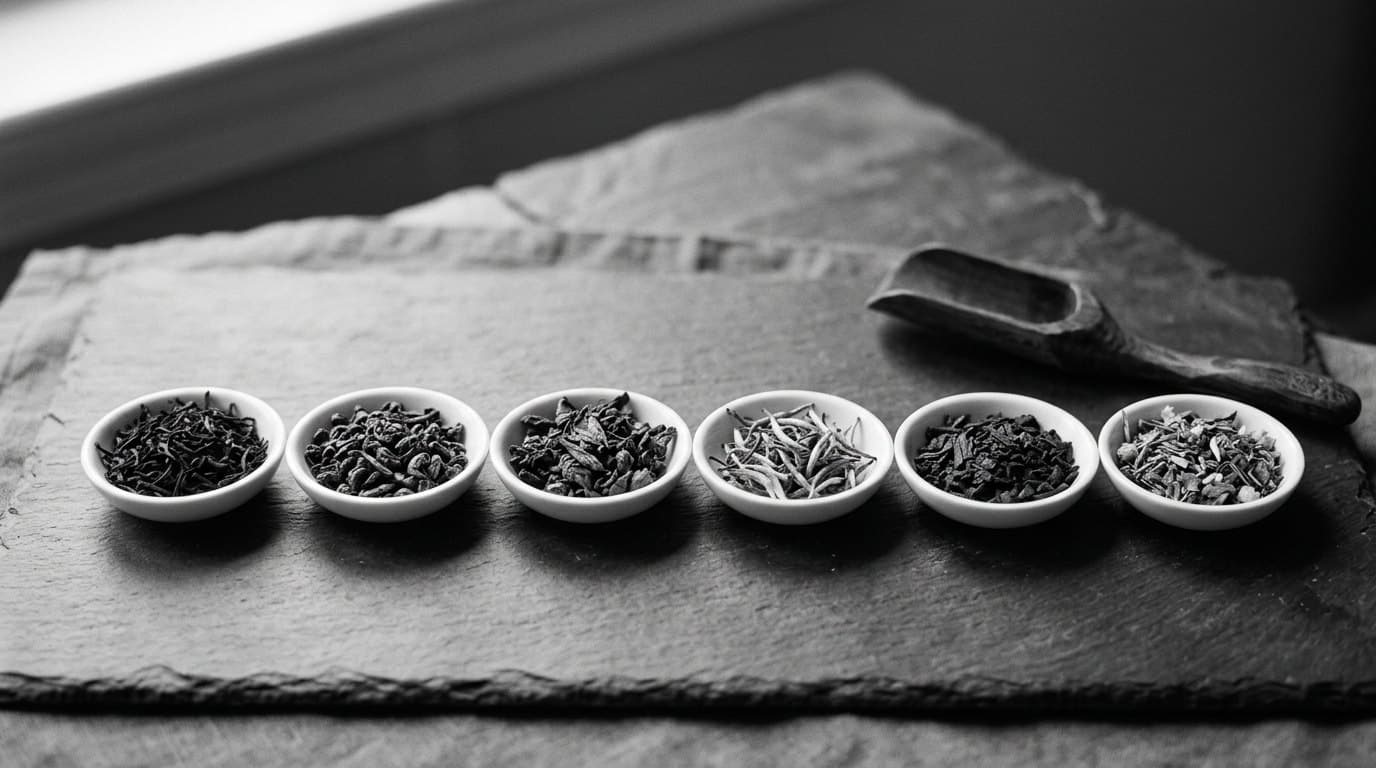
Types of Tea, Explained: Black, Green, Oolong, White, Pu-erh, and Herbal
Six categories, one plant (mostly). What each tea is, how it's brewed, and what to ask for when the menu runs to forty lines.
Tea Rooms.org Editors · September 1, 2026
Every true tea — black, green, oolong, white, and pu-erh — comes from one plant, Camellia sinensis. The differences come from what happens to the leaf after picking: how much it is allowed to oxidize, whether it is rolled, roasted, or aged. Herbal "teas" are the exception. They contain no tea leaf at all.
Oxidation level predicts taste, water temperature, and steep time. The timings below are starting points; a good room will give you its own.
Black Tea
Fully oxidized. The leaf is withered, rolled, left to darken, then dried. Brisk, malty, robust — the tea most Americans picture. English Breakfast, Earl Grey (black tea scented with bergamot), Assam, Darjeeling, and Ceylon all belong here.
Brew with water just off the boil, three to five minutes. Black tea takes milk well and is the default choice for a tiered afternoon tea, because it holds its own against cream, jam, and smoked salmon.
Green Tea
Unoxidized. The leaf is heated soon after picking — pan-fired in the Chinese tradition, steamed in the Japanese — which locks in a green, vegetal, sometimes grassy character. Sencha, dragonwell (longjing), gunpowder, jasmine green, and matcha (stone-ground green tea whisked into water) are the common names.
Green tea punishes hot water. Use water around 160–180°F and steep one to three minutes; boiling water turns it bitter within a minute. Order it at a tea bar or Chinese tea house, not with a tiered stand.
Oolong
Partially oxidized — anywhere from a light green-leaning style to a dark, roasted one — and often rolled into tight balls that unfurl over several steeps. Tieguanyin, Dong Ding, Wuyi rock teas, and the Taiwanese high-mountain oolongs cover the range from floral and creamy to toasty and mineral.
Brew at 185–205°F for two to four minutes, and re-steep: a good oolong gives three or more pours, each different. This is the category to explore at a gongfu-style tea house, where small pots and short, repeated infusions are the whole point.
White Tea
Minimally processed: young buds and leaves are simply withered and dried. Silver Needle (buds only) and White Peony (buds plus leaves) are the standards. The cup is pale, soft, and faintly sweet, with a hay-like or melon note.
Brew gently — 170–185°F, three to five minutes. White tea is the one to order when you want something calm and low on tannin.
Pu-erh
A fermented, aged tea from Yunnan, China, sold pressed into cakes or bricks or as loose leaf. Raw (sheng) pu-erh starts bright and mellows over years; ripe (shou) pu-erh is accelerated through a wet-piling process and tastes earthy, dark, and smooth from the start.
Rinse the leaf once with hot water, then brew at a full boil in short steeps. Pu-erh is a specialist's tea; you will find it on the list at serious Chinese tea houses and almost never at a hotel afternoon tea.
Herbal Tea (Tisanes)
Chamomile, peppermint, rooibos, hibiscus, ginger, lemon verbena — infusions of anything but the tea plant. Naturally caffeine-free — the reason to order one late in the day or for a child's cup.
Brew with boiling water for five minutes or longer; there is no tannin to over-extract. Rooibos, from South Africa, is the herbal that behaves most like a black tea and takes milk if you want it.
What to Order, By Room
At a formal afternoon tea, order black — the house blend, Earl Grey, or a Darjeeling if the list has one. At a Chinese tea house, ask for an oolong and let the counter walk you through the re-steeps. At a tea bar or retail shop, taste a white or a jasmine green before you buy. Herbal is the right call after 4 PM if caffeine keeps you up. Every listing on this site marks its styles so you can tell which kind of room you are booking before you arrive.
Explore the full directory
Verified hours, pricing, and booking for every tea room in Texas.
Browse Texas Tea Rooms